
Ford 6.8L Minizilla Engine Specs, Problems, Reliability, Info
6.8L V8 Mini Godzilla Info
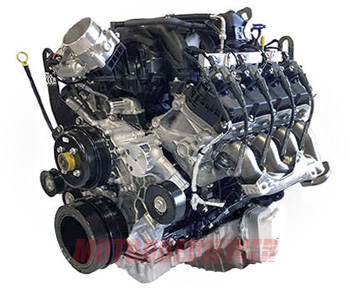
The Ford 6.8L Minizilla (or "Babyzilla") is a 6.8-liter naturally aspirated gasoline V8 engine developed by the Ford Motor Company and introduced for the first time in the 2023 Ford Super Duty lineup. It is essentially a short-stroke version of the 7.3-liter Godzilla engine that replaces the outgoing 6.2L Boss V8. The 6.8L mini-Godzilla, paired with the 10R100 TorqShift-G 10-speed automatic transmission, has become the standard engine for most F-250 and F-350 XL, XLT models. This classic OHV pushrod engine with port injection and variable camshaft timing delivers 405 horsepower at 5,000 rpm and 445 lb-ft of torque at 4,000 rpm. So, let's take a look at the 6.8L Minizilla engine and see how it differs from the 7.3L version.
Ford 6.8L V8 Minizilla Engine Features
The 6.8-liter version retains the same architecture and design as the Godzilla engine family. The core of this motor is a strong and durable cast-iron cylinder block with four-bolt main caps and cross bolts. The 6.8L block has a cast crankshaft, instead of a forged-steel crankshaft in the 7.3L Godzilla. It also has a shorter stroke, measuring 93.5 mm (3.681 in) compared to 101.0 mm (3.976 in). But the bore size remained unchanged. The compression ratio was increased from 10.5:1 to 10.8:1. The rest of the components are similar: hypereutectic aluminum alloy bowl-shaped pistons, cracked powdered metal connecting rods, piston oil jets, and a variable-displacement oil pump.
The engine block is covered with old-school aluminum heads. They feature two valves per cylinder, tall intake and exhaust ports, forged aluminum rocker arms with roller fulcrums, and Beehive valve springs. The camshaft seats inside the block (it's a pushrod V8), and it comes with variable valve timing and a single phaser. This engine also utilizes a conventional port fuel injection system: fuel is injected into the intake ports before the intake valves, rather than directly into the combustion chambers, like most modern direct-injected engines do. The intake manifold is made of plastic to reduce weight, and it has a simple design with a fixed geometry. The throttle body is electronically controlled, as well as the ignition, which features individual coils for each cylinder. The engine runs on regular 87-octane gasoline (2024+ models are flex-fuel capable).
The End Result
As you can see, this is a straightforward OHV V8 engine that will likely last a very long time. There is nothing overly engineered or complex about the design, unlike some of the modern V6 turbocharged and direct or dual-injected alternatives. 405 horsepower and 445 pound-feet of torque is a decent amount of power for a work truck, and it's not a huge difference compared to the 7.3-liter version. The towing capacity is about 4,000 lbs less (in a standard 6.8L F-350 it is rated for 14,300 lbs vs 18,200 lbs with 7.3L engine). On the other hand, it offers better fuel economy averaging between 13 and 16 MPG over the 10 to 14 MPG usually seen with the "older brother".
Engine Specs
Oil recommendations and capacity may vary depending on the car model, year, and market. Please check the service manual specific to your vehicle!
6.8L V8 Mini Godzilla Problems and Reliability
The Ford 6.8 L Mini-Zilla was built to last. It's just a mechanically simple workhorse that features a straightforward OHV pushrod design, no turbochargers, and no complicated systems with lots of electronics. All that is needed for heavy-duty commercial use. So far, the 6.8-liter version has been widely regarded as a very durable and reliable engine with no catastrophic failures or design flaws. However, there is no perfect engine in the real world, and this one is no exception. So, let's take a look at some of the most reported problems with the 6.8L Mini Godzilla engine.
Oiling System Issue
The engine is equipped with variable displacement oil pump instead of traditional constant-volume oil pump. In order to save some fuel, the amount of oil, provided by the pump to lubricate the components, depends on the load and all this is controlled by the ECU (engine control unit). This means that the oiling process is constantly pushed to its limits, which is not good for heavy duty use.
Fuel Economy
The 6.8L engine offers better fuel economy than the 7.3L version, but it is definitely not as efficient as more advanced Ford’s turbocharged V6 engines.
Minor Issues
Owners commonly report minor issues, including random electronic glitches, accessory failures, spark plug failures, exhaust manifold leaks, intake manifold leaks, PCV valve hose cracks, oil leaks, among others.
Ford 6.8L V8 Minizilla Longevity
Long-term high-mileage data is still emerging, but this engine shares architectural DNA with the proven 7.3L Godzilla engine. This means that the Ford's 6.8-liter Mini Godzilla has the potential easily to last over 300,000 miles with proper maintenance (do regular oil and filter change with 5k - 6k mile service interval, use a high-quality synthetic oil and good fuel, keep the cooling system functioning properly).